Elocution vs Public Speaking vs Accent Coaching

All three of these skills are different, though they do have some overlaps.
If you've been looking into elocution lessons, public speaking coaching or accent coaching, you might have noticed that these services are sometimes described in similar ways.
It's easy to get confused. They all involve speaking and developing the way you communicate, but each focuses on different skills and goals. Understanding the difference can help you choose the right coaching for what you actually want to improve.
What Is Elocution?
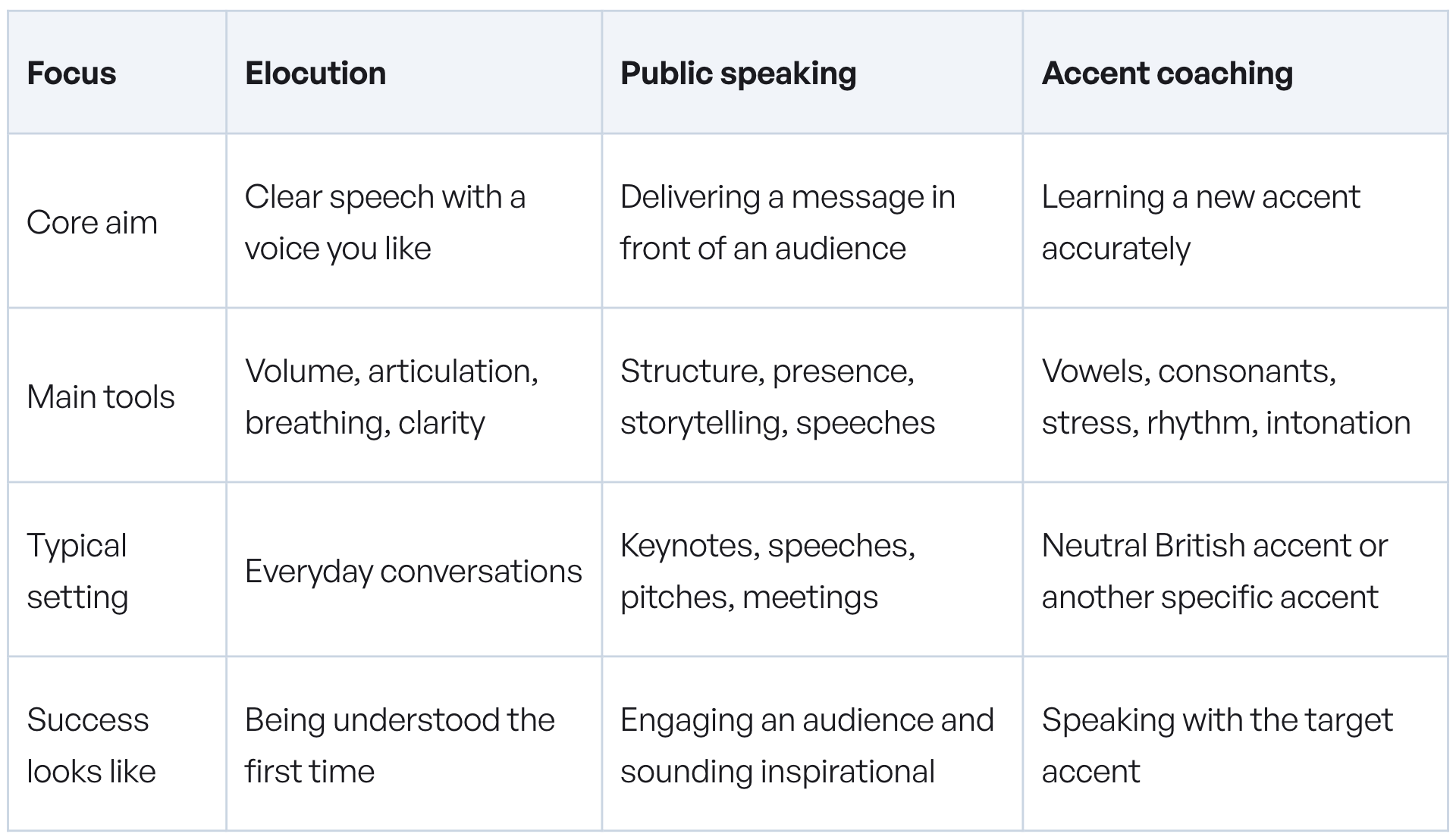
Elocution is the practice of speaking clearly and liking the sound of your voice. It focuses on how you form words, use your voice and communicate through speech.
You may need elocution if you are asked to repeat yourself frequently, maybe you speak too softly spoken and you want a more authoritative voice, you mumble when you're nervous or you struggle to articulate certain words. You might also feel that your voice sounds flat and you'd like to express yourself more naturally.
These are all areas you can work on through elocution coaching.
Elocution lessons can cover:
- Articulation: Forming words and sentences clearly and fluently.
- Projection: Helping your voice carry without shouting.
- Breathing: Developing better control over your breath when speaking.
- Pace: Speaking at a speed that allows people to follow you.
- Tone and expression: Using your voice to communicate meaning and emotion.
The aim isn't to make you sound posh or change your personality. It's about helping you speak clearly and feel more comfortable using your voice. If you want to change and train your voice, explore our elocution coaching.
What Is Public Speaking Coaching?
Public speaking coaching focuses on helping you communicate effectively in front of an audience.
You might need to deliver a presentation at work, pitch an idea to potential investors or speak at an event. Perhaps you know your subject well but struggle to organise your ideas or keep your audience engaged.
Public speaking coaching can help you develop skills such as:
- Presentation structure: Organising your ideas so your message is easy to follow.
- Storytelling: Using stories to make your message more engaging.
- Body language: Using gestures, posture and eye contact effectively.
- Managing nerves: Feeling more comfortable speaking in front of others.
- Audience engagement: Keeping people interested in what you have to say.
Elocution can support your public speaking, but it doesn't automatically teach you how to deliver an outstanding presentation.
You could have a beautifully clear voice but struggle to structure a talk. Similarly, you might be an engaging presenter but need to improve your articulation or projection.
If you want to become a more confident and engaging presenter, explore public speaking coaching.
What Is Accent Coaching?
Accent coaching focuses on learning or developing a particular accent.
For example, you might speak English fluently but want to develop a more neutral British accent. Alternatively, you might be an actor preparing for a role that requires a specific regional accent.
Accent coaching works on the sounds and patterns that make an accent distinctive, including vowels, consonants, word stress and the rhythm of speech.
You can speak clearly without changing your accent, and you can work on your accent without making public speaking your main goal.
If you'd like to develop your British English accent, find out more about British English coaching.
Elocution vs Public Speaking vs Accent Coaching
Why Are These Skills Often Confused?
People sometimes assume that speaking clearly means speaking with a particular accent. However, clarity and accent are two different things.
You can have a strong regional accent and speak exceptionally clearly. You can also speak with a neutral British accent and still mumble, speak too quickly or struggle to project your voice.
The same applies to public speaking. Being able to articulate your words clearly doesn't necessarily mean you'll feel comfortable standing in front of an audience.
It's important to identify the actual challenge rather than assuming you need to change your accent or become a better public speaker.
For example, if people regularly ask you to repeat yourself, you might benefit from learning how to stop mumbling.
Can You Work on All Three Skills Together?
Yes. These skills can complement one another, depending on your goals.
You might want to develop a British accent while also improving your articulation and confidence when presenting at work. In that case, working on more than one skill could be helpful.
However, you don't need to tackle everything at once. If your main concern is that people struggle to understand you, it makes sense to start with clarity and articulation.
The important thing is to understand your priorities and focus on the outcomes that matter to you.
Find the Right Coaching for You
At Speaking Voices, we offer different types of speaking and communication training to help you work towards your individual goals.
Explore elocution coaching, public speaking coaching or British English coaching to find the right starting point for you.
Frequently Asked Questions
Is elocution the same as accent reduction?
No. Elocution focuses on clear, expressive speech, including articulation, projection and tone. Accent coaching focuses on developing a particular accent. You can improve your elocution while keeping your existing accent.
Can elocution lessons help with public speaking?
Yes. Clear articulation and effective projection can improve your presentations. However, presentation structure, storytelling and managing nerves are separate skills that public speaking coaching can address.
Which type of coaching should I choose?
If you want to improve the clarity of your voice, consider elocution coaching. If you want to become a more confident presenter, consider public speaking coaching. If you want to develop a particular accent, look into accent coaching.