Public Speaking In Training London: 2026 Full Guide

Public speaking training these days covers a wide range of services and approaches.
Coaches bringing different areas of expertise to help people develop their speaking skills, from short evening workshops in central London to intensive small-group courses to self-paced online programmes and one-to-one coaching. But it’s important to find an approach that suits you, your goals and the way you learn, so let’s use this guide to break down what you need to know!
What a Public Speaking Coach Actually Does
A coach helps you understand how you come across when you speak, what you are doing well and what you could improve. They give you honest feedback and help you work out how to get your message across in the way you want. Much of the work involves practising simple techniques, getting feedback and building skills over time so you can feel confident with speaking.
In the first session, you might start by speaking about something you know or answering a question on the spot, some sort of vocal assessment to assess how you are currently speaking. Your coach will listen and look at things like how quickly you speak, your tone of voice, volume, use of filler words, posture and eye contact. You might notice things you hadn't realised you were doing, as well as things you're already doing well.
Who Improves On Their Public Speaking Skills
The range of people booking public speaking sessions is getting more popular and due to the increased demands of AI, we have to recognise the importance of our communication skills, the connection between humans and how we express ourselves. This is why more and more people are looking to improve their speaking skills.
- Professionals who present in high-stakes meetings and want clarity of speech, to be calm and deliver their message with impact.
- Conference and keynote speakers who need storytelling, motivation and presence, not present factual content.
- Non-native English speakers who want to be understood easily and sound more assured.
- People with social anxiety or a long-standing fear of speaking, including those who have avoided it for years.
- Wedding speakers, you can’t get AI to speak to their loved ones.
- People facing media interviews or on-camera work.
- Business owners and entrepreneurs who want to communicate their value clearly, pitch to potential clients, network confidently and win more business.
- People preparing for job interviews who want to communicate their strengths, answer questions clearly and come across with confidence.
- People who want to develop their self advocacy skills and feel more confident speaking up for themselves, setting boundaries and making sure their opinions are heard without feeling the need to apologise for having a voice.
Many people look into public speaking training as part of their personal development. They want to understand themselves better and and continue growing as a person.
Voice Coaching and Public Speaking Coaching: What Is the Difference?
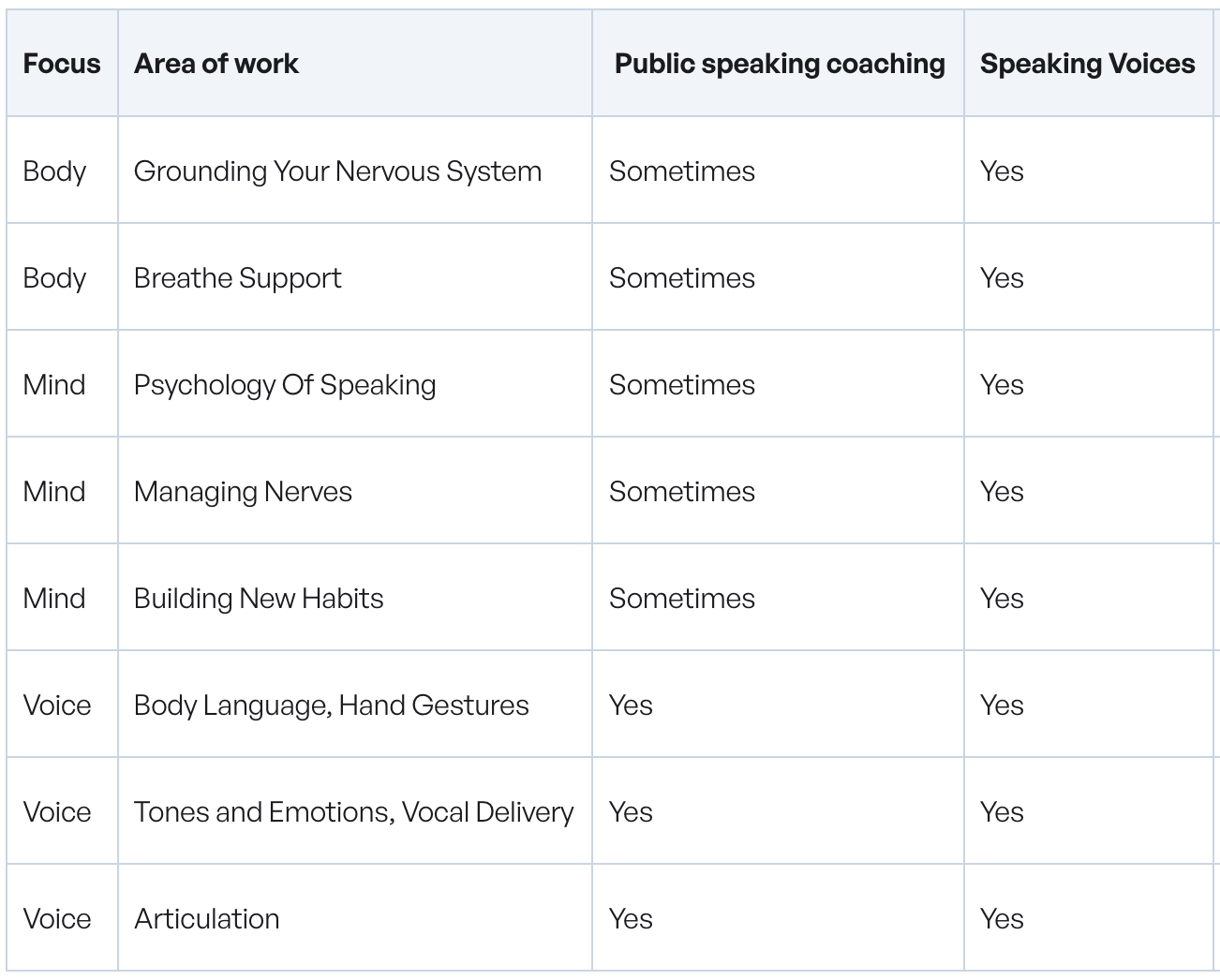
The two overlap, but they start from different questions. Voice coaching thinks about how the instrument is working and works on the whole body whilst public speaking coaching works on what you are trying to do achieve with your speech and to who you are speaking to.
At Speaking Voices we work on voice coaching incorporating our three part philosophy, the body, mind and voice as we believe once you are able to ground your nervous system and breathe, you are able to think clearly and articulate yourself the way you want to.
Public Speaking Courses And Voice Coaching Courses
Public speaking courses often focus on developing presentation skills, structuring a speech, engaging an audience, using storytelling and managing nerves when speaking in front of others. Voice coaching courses tend to focus more on the way you use your voice, you can change your voice if you don’t like it, so you feel comfortable when you speak at any capacity.
A public speaking session may leave you with a clearer with how to say your speech, but may not like your voice still. A presentation skills session may leave you with a solid structure but you’re still fighting with your nerves. A voice coaching session may leave you with a lot of inner pyschological work but less practice in a group setting.
Group Coaching Or One To One Coaching?
Another consideration is whether you choose group coaching or one to one coaching. Group courses give you the opportunity to practise with other people, learn from their experiences and develop your skills in a supportive environment. They can be particularly useful if you want to build experience speaking in front of a group and become more comfortable presenting to an audience. For example like Toastmasters, around 20 people in a group and you all take it in turns to speak. This approach may not suit everyone as it’s a sink or swim feeling. Some people really do not like being thrown in the deep end.
One to one coaching offers a more personalised approach. Sessions can be tailored to your individual goals, challenges and learning style, with time to explore the specific areas you want to improve. You might want to speak up more confidently in meetings, express your thoughts more clearly, manage anxiety when speaking or develop your voice and delivery. This approach is more gentle where we slowly get you to open up and build up your speaking skills.
Neither approach is automatically better than the other but this heavily depends on what you want to achieve and the kind of support you need. For some people, practising alongside others is an important part of building confidence. For others, having individual attention and the space to work through personal challenges is a better starting point.
At Speaking Voices we pride ourselves in working 1 to 1 with people, taking the time to understand their individual experiences with speaking. Alongside developing practical speaking skills, we explore the psychological side of communication, helping clients understand how past experiences and beliefs may influence the way they speak today. This can include recognising patterns of how we think, working through fears and building a healthier relationship with their voice.
Pricing Point That Suits You
Depending on experience and qualification of different coaches, prices can vary. There are a wide range of options to suit what it is that you are looking for.
- Self-paced online masterclasses including free ones, suit people who want an introduction on their own schedule.
- Short evening group classes including formats built around three two-hour workshops, suit those who want structure without a long commitment.
- Two-day group courses suit people who have avoided public speaking for years and want an intensive push.
- Up to 1 month programmes requires a bit of planning but gives a deeper insight to work on those techniques.
- 3 Months or longer normally cater for one to one coaching suits people who want a transformation on their communication skills, working on those deep psychological blocks or specific skills.
Even though, the price is something to consider, it’s worth looking beyond the initial cost and considering how much you want to invest in yourself to develop this life long skill. Will you practise using the techniques after a one hour public speaking workshop? It’s like going to the gym, the trick is that you have to maintain it rather than go once.
At Speaking Voices, this is why we only offer our three month one to one programme as we see the most change and the biggest transformations in our clients. It gives you the time and personalised support to work on your speaking skills in depth. We give you homework to practise daily and unlimited Whatsapp support to ask use questions or for you to send us videos and for us to give you constant feedback.
Rather than focusing on a quick fix, we help you develop your confidence, voice and communication skills over time, so you can apply what you learn to meetings, presentations, interviews and everyday conversations. The aim is to give you skills you can continue using long after your coaching has finished.
If this is something you want to invest in, check out our range of communication services here.
Frequently Asked Questions
How long does it take to feel more confident at public speaking?
Most people notice a difference after a handful of sessions, particularly when they rehearse between appointments. Deeper change, especially where fear has built up over years, usually takes a few months of deep work. The pace depends on how often you practise and how much speaking exposure you can arrange in daily life.
Do I need experience to start public speaking training?
No. Many clients have never spoken at big events and some have actively avoided it for years. Courses and one-to-one coaching are usually built for complete beginners as well as experienced speakers and a good coach will assess where you are in the first session rather than assuming a baseline.
Is online public speaking coaching as effective as in person?
For most delivery skills, yes. Online sessions still allow full feedback on structure, pace, gesture and eye contact through the camera, and they remove travel time. In-person work has the edge for large-room projection and stagecraft, so some clients mix both depending on the event they are preparing for.
Can coaching help with a genuine fear of public speaking?
It can help considerably. Fear of speaking, sometimes called glossophobia, responds well to gradual exposure, breathing work and examining the beliefs underneath the panic. At Speaking Voices we offer Speak Confidence and Speak Social Anxiety depending how scared you are with speaking.
Should I choose a group course or one-to-one coaching?
Group courses offer practice in front of an audience and often cost less per hour. One-to-one coaching covers a range of topics, confidential material, strong anxiety or a specific event such as a wedding speech or conference keynote. Many people start with individual sessions and later join a group to test themselves in a live room.